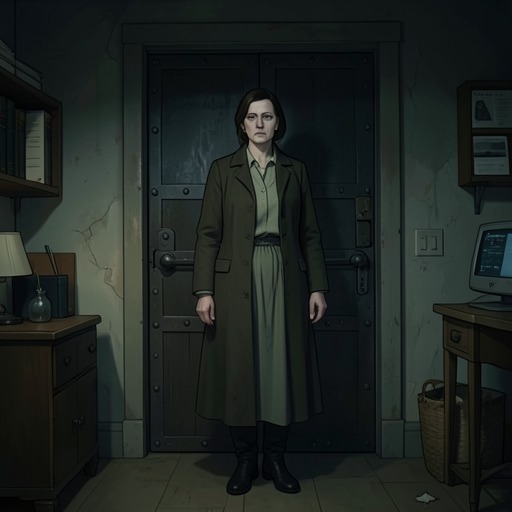
Kumiko’s letter
The Wind-Up Bird ChronicleKumiko’s letter is not a single, settled confession but a communication that changes as more of Kumiko’s story becomes known. The letter Toru receives asks him to accept their separation and not look for her; a later document presented as “Kumiko’s Letter” reveals that her first account concealed a wider history and announces her plan to kill her brother, Noboru Wataya. Together, the letters turn an intimate object into an unstable record of guilt, silence, and the effort to speak before time runs out.
The letter that arrives
After returning from the well, Toru checks the mailbox and finds a single envelope with no return address. He recognizes Kumiko’s precise handwriting, in which the small characters seem almost drawn. The postmark is smudged; he can make out parts that suggest Takamatsu, but has no known reason to connect Kumiko with that city. The uncertain postmark gives the letter a destination-like clue without explaining where she is.
At the kitchen table, Toru opens the envelope carefully and reads that Kumiko knows her sudden, unexplained disappearance must have shocked and worried him. She says she had intended to write sooner, but could not decide how to express her feelings or explain her situation. Her apology establishes the letter as a delayed attempt at explanation, while its careful physical details—the familiar handwriting and blue-black ink—bring her recognizable presence into a home from which she has vanished.
Confession and separation
Kumiko’s first account admits that she had been sexually involved with a man she met through work for nearly three months. She says the relationship is over and identifies the man as someone Toru does not know. She also insists that she cannot determine whether she loved him, while affirming that she loved Toru and had been glad to marry him. The confession therefore does not present the affair as a simple replacement of one attachment with another; it leaves the contradiction between her stated love and her departure unresolved.
She writes that an overwhelming desire, which she cannot explain, dismantled the life she and Toru had built, taking from her their home, her work, and her husband. She connects this bewilderment with an earlier silence: three years after her abortion, she had told Toru there was something she needed to say, but had not been able to tell him what was in her heart. She now suspects that putting those feelings into words would have made the damage more decisive, and describes swallowing them and disappearing as the course she chose. The letter thus makes her absence part of a longer pattern of things left unspoken, not merely a response to the affair.
Kumiko also says that she had not experienced genuine sexual pleasure with Toru, although she valued his embrace, and describes an inner blockage that she could not account for. She does not assign responsibility for this to him. She mourns the delicate closeness they once shared, while saying that something caused her to destroy it and that she wants to find and judge that cause. Yet she casts the search as her problem alone, separate from Toru’s responsibility. Her explanation is therefore both an apology and a refusal to let him take charge of what she believes she must confront.
Instructions to Toru
The letter’s practical requests are unambiguous even where its account of causes is not. Kumiko tells Toru not to concern himself with her or try to find her, and asks him to forget her and begin a new life. She says she will write to her family to make clear that he is not responsible, expects formal divorce proceedings to begin soon, and asks him not to protest. She also tells him to dispose of or donate the belongings she left behind, treating the objects of their shared life as things she no longer has the right to use.
She ends with a simple goodbye. Toru reads the letter again, returns it to its envelope, and takes some relief from the prospect of divorce proceedings: he reasons that Kumiko does not intend to kill herself immediately. That reaction shows how little the letter resolves. It reassures him about one immediate danger while its request not to search directly conflicts with his continuing concern and leaves her whereabouts unknown.
The later document
During the night, after hearing sleigh bells, Toru goes to Cinnamon’s office and reads a message on the computer. He gains access to the program “The Wind-Up Bird Chronicle,” selects document 17, and finds a text headed “Kumiko’s Letter.” Its form recalls the mailed letter but its timing and contents change what the earlier confession can mean. Kumiko says that she has much to explain, but that there is no time for a full account; she will state the most important thing first.
She announces that she intends to go to the hospital room where Noboru Wataya is sleeping, disconnect his life-support system, wait until she is sure he is dead, and surrender to the police. She says she will offer no explanation or defense, and expects to be arrested and tried. The message shifts the letters’ immediate stakes from marital separation to a deliberate act with criminal consequences. Unlike the earlier request that Toru begin a new life, this document presents Kumiko as acting against her brother and accepting imprisonment as a possible result.
The later text also revises the earlier account of her relationships. Kumiko admits that the claim she had slept with one man was untrue: she had slept with many, too many to count. She speculates that Noboru Wataya may have influenced this behavior, while acknowledging that she does not understand its cause. She says he had similarly harmed her sister, who later died by suicide, and describes his power as affecting them beyond what can be explained as bodily harm. These disclosures do not supply a complete explanation; they expose how much the first letter had withheld and leave Kumiko questioning whether the self writing now can be trusted as the real one.
Form and significance
The two versions of the letter make correspondence a partial, revisable form of knowledge. In the first, Kumiko gives Toru a comprehensible outline—an affair, guilt, a request for divorce—while withholding the broader history that the later document discloses. The second text is not simply an expansion of the first: it corrects a central claim, changes the reader’s understanding of Kumiko’s relationships, and introduces a plan whose consequences extend beyond the marriage. Each account is a statement made under different pressures, and neither removes all uncertainty about what happened or how Kumiko understands herself.
As an object, the letter also carries Kumiko’s presence across her absence. The mailed sheet reaches Toru through an envelope with no return address; the later text reaches him through Cinnamon’s computer, as a numbered document in “The Wind-Up Bird Chronicle.” In both cases, access to her words depends on a medium that can deliver testimony without restoring direct contact. The movement from a request to be forgotten to an announcement of intended action gives the letters their decisive force: they record not a completed reconciliation, but Kumiko’s changing attempt to name what happened and determine what she will do next.